
In development, piloting now
Growbud AI
Five systems, one model of the house.
Sensing, control, vision, AR/VR, and the fusion algorithms that reconcile them. Each is useful alone and you may already run two of them. Together they stop being separate readings and become a model of your greenhouse you can walk through.
What it is made of
Five strands, fused.
When readings, irrigation events, and photographs share one timeline, you can scroll back to any hour in any bay and see all three at once.
What the crop is actually in.
VWC and EC from Dro and Vero at the depth you placed them, air temperature and humidity per bay from the Climate Sensor, on the interval you set.
What the house did about it.
Valves, vents, lights, and switches from the Controller. Every action lands on the same timeline as the measurement that prompted it.
What it looks like.
A weatherproof zoom camera per bay, parked on named presets and photographed on a schedule. The same frames every time, so what changes is the crop.
Somewhere to stand.
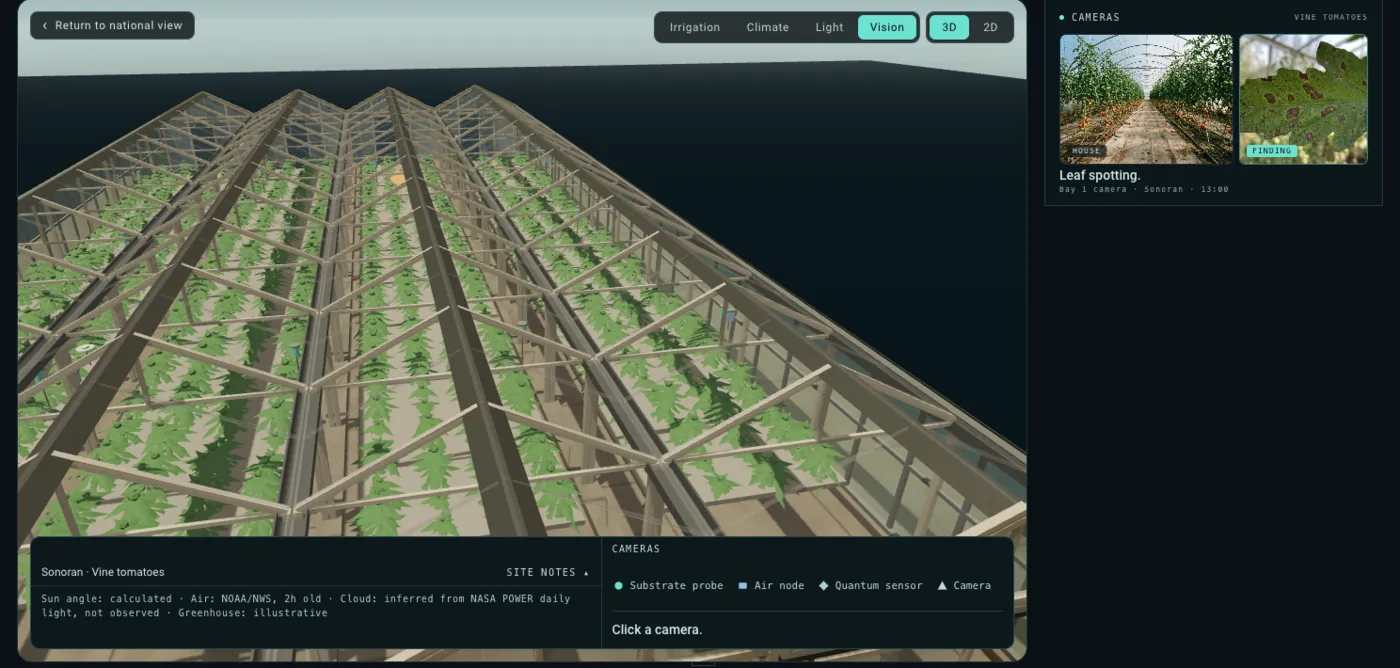
The twin is spatial, so it can be walked rather than read. Look at a bay in a headset from anywhere, or hold the model against the real house while you are standing in it.
The part that makes it one thing.
Readings, actions, and imagery arrive at different rates from different places. The fusion layer reconciles them into a single current state per bay, and runs on your own hardware.
Security matters. Your data stays yours.
We take the security of your operational data and photographs seriously. Whether you run Growbud AI on site or in our managed cloud, we won’t use your data to train AI models unless you explicitly agree.
It runs on hardware you already own. Growbud AI does not ask you to re-instrument the house. It reads the sensors and controllers already in it, and adds the camera and the model on top.
Inside the vision strand
A greenhouse asks three things of a camera at once.
Worth one section because it is the strand most often done badly. Most cameras manage one or two of these; the gap is why greenhouse imagery so often disappoints.
- 01
Take the weather
Spray, wash-down, and condensing humidity are normal in a wet house. The camera is rated IP66/IP67 and specified to 100% relative humidity, condensing.
- 02
See the whole bay
Mounted at the head-house end under the gutter, one camera looks the length of its bay. You get the row, not a keyhole.
- 03
Fill the frame with a leaflet
31x optical zoom resolves a single leaf from across the house. Optical, not digital, so the detail is real rather than interpolated.
Which is why the obvious answers disappoint. An indoor dome camera fails the first: It is built for a dry ceiling. Condensing humidity and wash-down spray end it. A fisheye "360" camera fails the last: It sees everywhere at once and nothing closely. There is no optical zoom, so a leaflet is a handful of pixels no matter how many megapixels the sensor claims.
The camera
One body that does all three.
The evaluation kit ships two cameras, one per bay, mounted at the head-house end under the gutter. Each is cabled with a sealed push-pull RJ45 connector: without the gland at the camera end, the ingress rating on the datasheet is not the rating you have in the house.
Four presets per camera cover the bay end to end. Growbud AI drives the camera to a named preset, waits for it to settle, and takes a still.
- Environmental
- IP66 / IP67, 10-100% RH condensing
- Optical zoom
- 31x
- Pan
- 360 degrees, endless
- Presets
- Up to 300 named positions
- Per bay
- One camera, four working presets
Where it runs
On your box, or on ours.
The same platform either way. The difference is who looks after the hardware and where the photographs live.
Fully on-prem
A compact workstation in the head house holds the twin, the time-series history, and the image store, with the cameras on their own network segment. Photographs are written to an encrypted volume and kept to a retention window you set. Nothing is uploaded off site, and it keeps working when the connection does not.
Managed cloud
We run the platform and you reach it from anywhere, with updates, backups, and capacity handled for you. Same model, same timeline, same bays, without a box in the head house to look after or a GPU to buy.
Both take stills rather than streams: scheduled photographs at known positions, not a live video wall. There is no security DVR here, so there is less to break and far less to store.
Get involved
Join the pilot or get launch updates
Growbud AI is in active development. We’re testing kits in greenhouses as we build, using the sensors, controllers, and Edge Server available on this site.
Help shape it. Try a pilot kit in one or two of your greenhouse bays, with hands-on support from our team. Your feedback will help guide what we build.
Hear when it’s ready. Interested, but not ready to test? Sign up for a launch notification. We’ll only contact you when Growbud AI is ready.